

Automotive Component Remanufacturing
at the Mirafiori Circular Economy Hub
In the automotive industry, the transition toward more sustainable production models increasingly relies on the ability to integrate industrial remanufacturing, certified quality and higher production volumes.
Within this context, the project was launched at the Mirafiori Circular Economy Hub, a facility owned by Stellantis and inaugurated in November 2023 as the Group’s first site entirely dedicated to circular economy activities through an integrated approach.
Driven by increasing demand, product range expansion and sales growth forecasts, the need emerged to develop a circular economy project focused on increasing production capacity.
The objective was to achieve this while maintaining quality standards aligned with a highly structured industrial environment, where every stage of the process must be measurable, repeatable and fully integrated into existing production flows.
Doubling Test Capacity While Maintaining Industrial Quality
Within the production capacity expansion plan of the Mirafiori Circular Economy Hub, the testing area represented a key challenge.
Industrial remanufacturing requires that every component leaving the line undergo functional and performance testing to ensure performance equivalent to that of a new component.
Key requirements:
Doubling Testing Capacity Without Slowing Production Flows
Forecast volumes required doubling the existing testing capacity while maintaining cycle times aligned with time-to-market requirements. Adding equipment alone was not sufficient. The process had to be redesigned to ensure efficiency and operational continuity.
Integrating New Product Families with Differentiated Testing Parameters
The expansion of the product portfolio required testing different types of powertrain components, each with specific functional and performance testing cycles.
Ensuring Full Traceability and Regulatory Compliance
In a certified automotive environment such as Stellantis, every test result must be recorded, stored and automatically integrated into management systems. This ensures full traceability across the entire production value chain.
Ensuring Process Automation and Repeatability
Human variability had to be minimized. Testing processes needed to be fully automated, with standardized cycles and objective acceptance parameters aligned with OEM quality standards.
Adapting to the Existing Layout Without Interrupting Production
The new equipment had to be integrated into the production flows of an already operational facility, without affecting production continuity.
Technical Coordination and Industrial Collaboration Approach
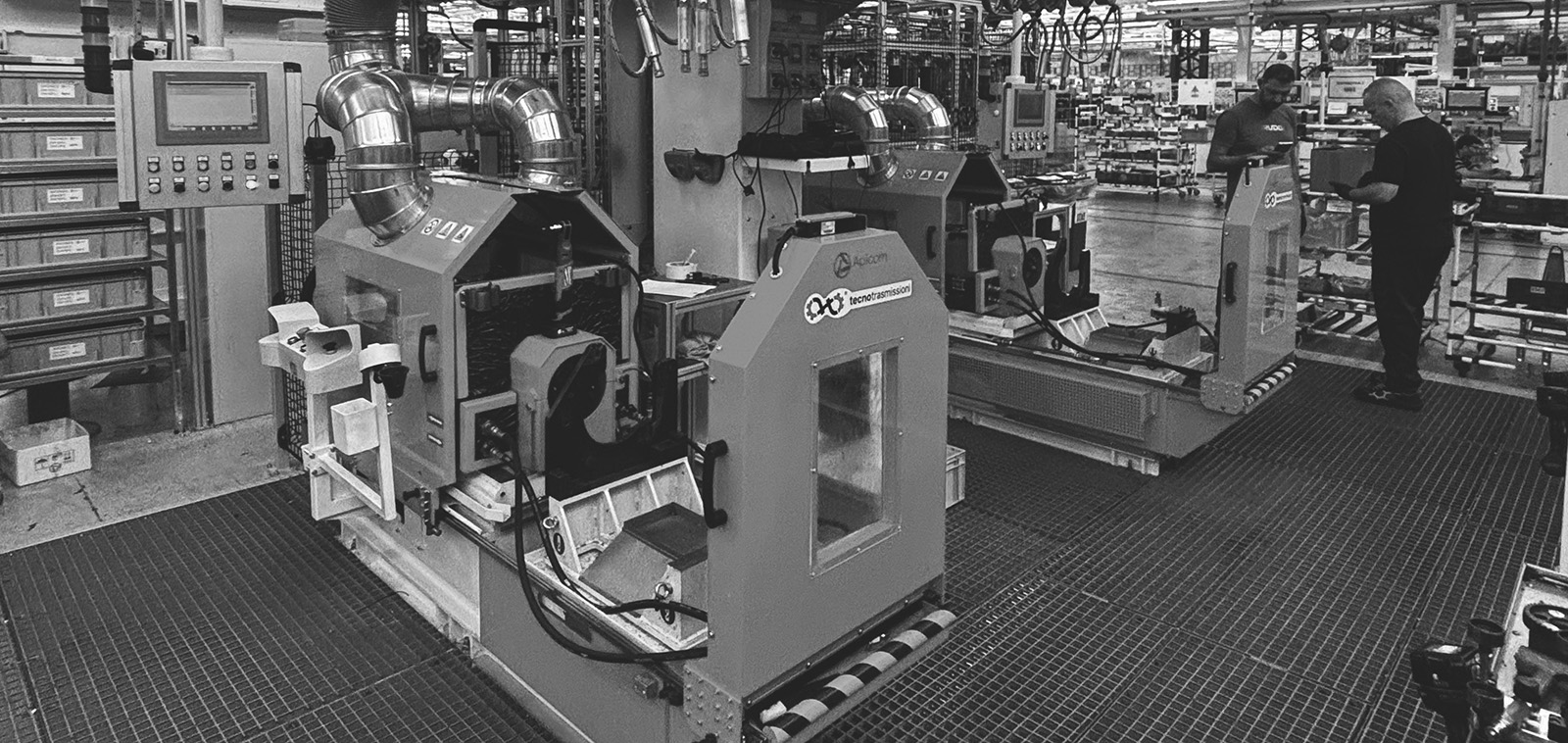
Our involvement began with the analysis of operational requirements and resulted in the supply of two test benches developed in collaboration with APICOM, a company specialized in the design of testing equipment for the automotive sector.
We promoted and coordinated a structured collaborative process involving continuous interaction between the end customer, the equipment manufacturer and our technical team. The objective was to translate complex operational requirements into concrete engineering solutions through a series of defined phases.
- Definition of functional requirements, including components to be tested, technical parameters and acceptance criteria.
- Definition of testing parameters, including test cycles, cycle times, data acquisition and validation protocols.
- Integration into existing processes, ensuring compatibility with information systems, plant layout and production flows.
The Solution, Custom-Engineered Test Benches
The test benches were developed according to the customer’s technical specifications and designed to integrate seamlessly into existing production flows. These custom-engineered solutions were built to meet precise technical requirements, from test cycle configuration and cycle time definition to full compatibility with the internal plant layout.
Key features:
- Full cycle automation. The system operates autonomously and automatically generates compliance reports.
- Data traceability. Every test is recorded and integrated into the management system without manual intervention.
- Modularity and scalability. The system can be adapted to new powertrain component types with minimal software and hardware modifications.
Once the component is loaded and the test cycle is initiated, the bench follows a predefined protocol to verify functional and performance parameters, ensuring repeatable cycle times and reducing human variability.
The data generated are automatically integrated into management systems, ensuring full traceability from initial verification through to sale. This enables more efficient management of warranties, recalls and regulatory compliance.
The modular approach allows the application scope to be extended over time without replacing the entire equipment, making the investment scalable in line with business growth.
Tecnotrasmissioni as Technical Partner of the Mirafiori Circular Economy Hub
Tecnotrasmissioni participated in this project as a technical partner capable of coordinating the development, validation and integration of advanced testing solutions.
Our role was that of project facilitator and industrial integration partner. We technically coordinated the end customer’s requirements with the equipment manufacturer’s capabilities, translating operational needs into implementable specifications.
Acting as a bridge between demand and solution required strong technical expertise in automotive remanufacturing and the ability to oversee the entire development cycle, from design through to final system validation.
Results. Testing Capacity Doubled
The project delivered measurable results both operationally and strategically.
Thanks to the introduction of the test benches, testing capacity was doubled, enabling the site to support increased volumes within the remanufacturing departments. This capacity expansion also supported the extension of the product portfolio with four new product families, strengthening the strategic role of the Mirafiori Circular Economy Hub within the Stellantis production network.
From a sustainability perspective, the project makes a concrete contribution to automotive circular economy objectives. Each remanufactured component extends the product life cycle, avoiding the production of a new part and reducing the consumption of raw materials and energy.
Remanufacturing recovers components that would otherwise be scrapped, reducing waste, while process automation and traceability optimize resource usage, improving production efficiency without proportionally increasing deployed assets.
A Replicable Model for Automotive Circular Economy
Tecnotrasmissioni is an Italian company specialized in the remanufacturing of gearboxes and transmissions for passenger cars and commercial vehicles, with industrialized processes certified ISO 9001 and IATF 16949. Remanufacturing is at the core of our business model, supported by a sustainable approach that extends the life cycle of automotive components and anticipates the sector’s circular economy requirements.
The project at the Mirafiori Circular Economy Hub confirms our ability to operate as a technical partner in large-scale industrial initiatives. It represents a replicable collaboration model for OEMs and automotive manufacturers seeking technical partners capable of integrating advanced testing solutions in support of circular economy strategies
Discover how we can support your automotive circular economy project.