

Remanufactured gearboxes: a guide to technical requirements and OEM specifications
When evaluating a remanufactured gearbox for B2B supply, the key question is not just whether it works, but: will it perform reliably over time? Can it be installed without issues? Will it meet the performance standards expected by the vehicle manufacturer?
The answer depends on one specific factor: compliance with OEM technical requirements in the remanufacturing process. A gearbox may be compatible with an application without being compliant with the manufacturer’s specifications. This difference, in a structured supply context, results in returns, functional issues and unplanned costs.
In this article, we analyse what these requirements are, how they are verified during the production process and why systematic compliance is the variable that distinguishes a reliable supplier from an inconsistent one.
Non-compliant remanufactured gearboxes: technical risks and operational impacts
A remanufactured gearbox that does not meet the required technical standards generates operational inefficiencies that undermine reliability and lead to unexpected costs.
The most common operational consequences are:
- difficulty or impossibility of installation, with unplanned vehicle downtime;
- functional issues detected after installation: abnormal noise, vibrations, oil leaks, incorrect gear ratios;
- reduced component lifespan and risk of premature failure;
- increase in returns and warranty claims, with direct and indirect management costs;
- impact on reputation towards the end customer.
For those managing structured volumes, returns and rework represent a recurring cost factor that erodes margins and, over time, compromises the stability of the supply relationship.
OEM specifications in remanufactured gearboxes: what they include
OEM specifications (Original Equipment Manufacturer) do not only concern component dimensions. They define a complete system of measurable technical parameters that must be met to ensure the correct functioning of the gearbox within the vehicle.
In particular, they include:
- dimensional tolerances and component fit: essential to ensure proper applicability and installation without corrective interventions;
- tightening torques, to ensure correct assembly and long-term component stability;
- sealing and operating pressures to guarantee proper system performance;
- NVH standards for noise and vibrations to meet the comfort and performance levels defined by the manufacturer;
- gear ratios to maintain the functional characteristics of the vehicle;
- materials and component treatments to ensure resistance and durability over time.
When all these parameters are met during the remanufacturing process, the result is a component that installs without issues, performs correctly from first use and maintains its performance over time. It is this systematic compliance that makes the product reliable.
For distributors and OEMs managing structured supply, product predictability and repeatability are key variables. A reliable partner is able to ensure OEM compliance consistently, across every remanufactured unit.
Technical requirements in remanufactured gearboxes: the role of the process
Compliance with OEM requirements is the result of a structured industrial process, with objective and measurable controls at every stage.
The difference between a standardised approach and an empirical one can be measured in terms of product repeatability, reduction of non-conformities and consistency of quality standards over time.
A compliant remanufacturing process includes:
- complete disassembly of the gearbox and industrial cleaning;
- systematic dimensional inspection of each component (shafts, gears, bearing seats) carried out in a metrology room;
- tolerance checks according to OEM reference specifications;
- replacement of worn components based on defined technical criteria;
- restoration of functional surfaces;
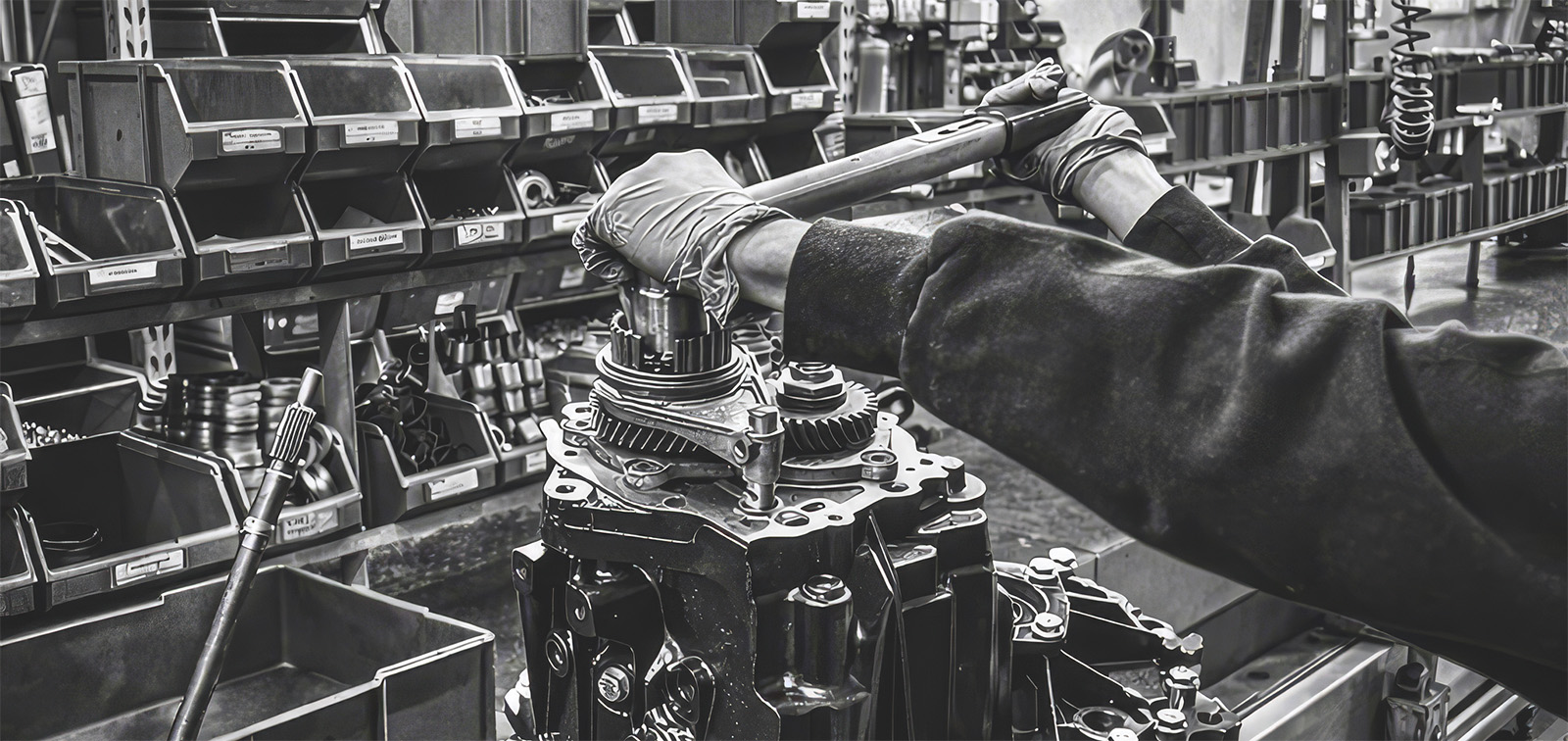
- reassembly according to defined tightening torques, verified with calibrated torque wrenches;
- leak testing;
- functional testing on a test bench before delivery.
Each stage is verifiable and traceable. It is a preventive and systematic approach that restores the entire transmission assembly to its original technical condition.
How Tecnotrasmissioni ensures OEM compliance in remanufactured gearboxes
At Tecnotrasmissioni, we remanufacture manual and semi-automatic gearboxes by applying a standardised industrial process, certified ISO 9001 and IATF 16949, which meets the technical specifications of vehicle manufacturers at every production stage.
Compliance with OEM requirements is verified through objective controls throughout the entire process:
- metrology room for dimensional checks and tolerance verification;
- calibrated torque wrenches for tightening torque control;
- leak tests to verify proper system sealing;
- in-house test benches, designed internally, for final functional testing.
The in-house design of test benches is a key differentiator: it ensures full control over the quality of the testing process and the ability to adapt verification procedures to the specifications of each model.
The IATF 16949 certification defines quality management system requirements for the automotive sector and ensures process control, traceability and repeatability.
Over more than 35 years of activity, we have developed know-how covering over 2,000 models across 30 different brands. In cases of direct supply to OEMs, products may undergo OEM validation processes.
Why OEM compliance is a competitive advantage in B2B
Choosing a remanufactured gearbox compliant with OEM technical requirements has concrete and measurable consequences on supply management:
- immediate installation, without the need for corrective interventions in the workshop;
- correct operation and expected performance from first use;
- reduction in returns and warranty claims;
- supply planning based on solid and predictable assumptions;
- perceived reliability by the end customer preserved over time.
The standard 12-month warranty covering all Tecnotrasmissioni gearboxes is the direct result of a structured and verifiable compliance process.
For those managing B2B supply in the automotive sector, compliance with OEM technical requirements is the condition that distinguishes a reliable remanufactured gearbox from a component with operational risk. It is the foundation on which a stable, repeatable and sustainable supply relationship over time is built.
Are you evaluating a remanufactured solution for B2B supply?
Contact us for technical advice on your application.